

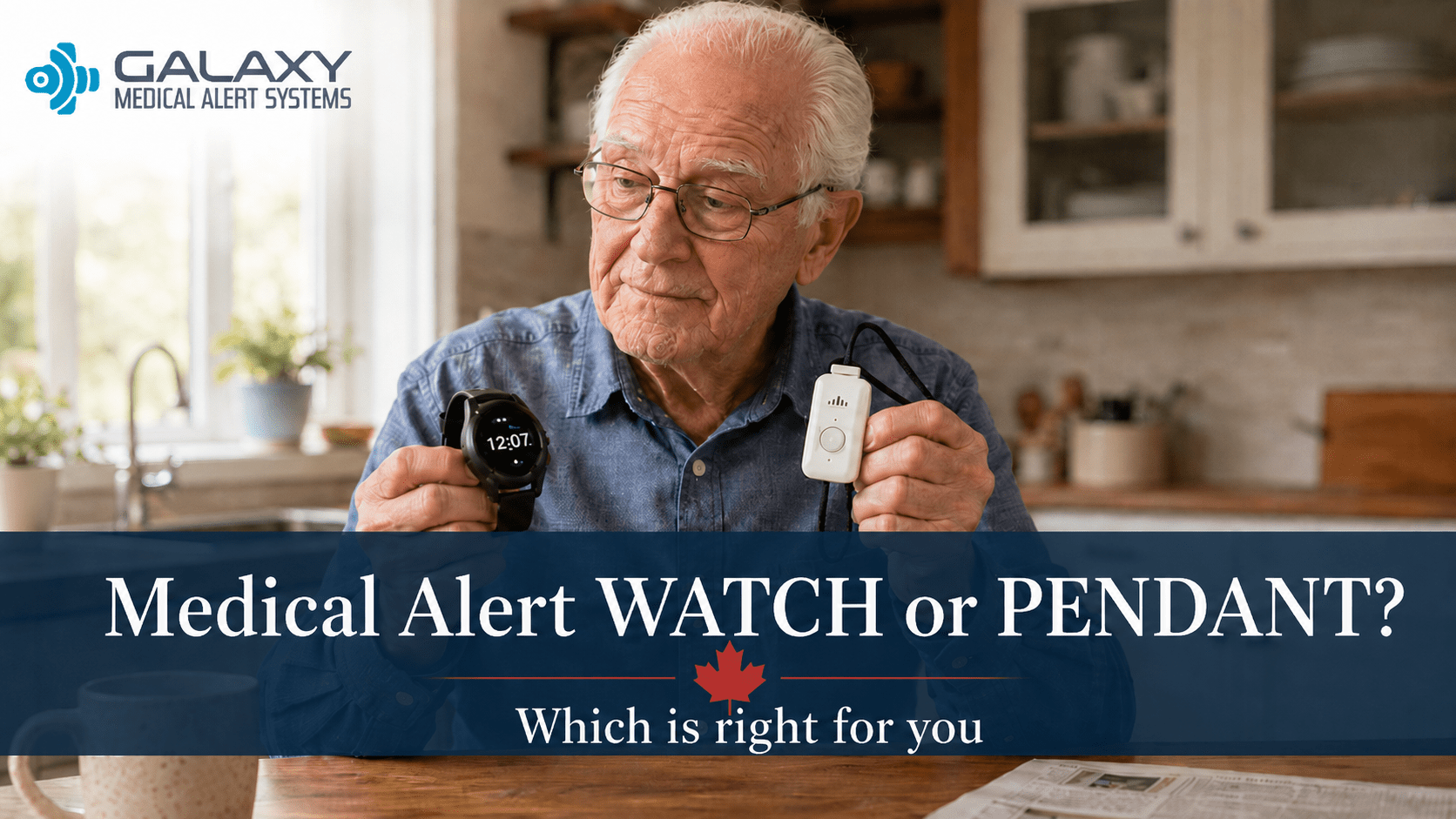
When it comes to a medical alert watch vs pendant, Galaxy’s two options cost exactly the same, $49.95 a month, run on the same 4G LTE network, use the same GPS and WiFi location technology, and even trigger fall detection with the identical logic: if the device tips from vertical to horizontal and no movement is detected for 10 seconds, it automatically alerts Galaxy’s monitoring centre. So the decision between them has almost nothing to do with technology. It has everything to do with which one your parent will actually keep on.
Why “Fall Detection” Isn’t the Whole Story
A 2017 peer-reviewed study of personal emergency response system use (Agboola et al., BMC Health Services Research), covering more than 78,000 recorded help button presses, found that falls accounted for 43.2% of incidents, while physical or psychological symptoms not related to a fall (breathing trouble, chest pain, dizziness, confusion) accounted for 42.7%. In other words, the button gets used almost as often for “something feels wrong” as it does for an actual fall. That matters for this comparison because a device that’s easy to reach with unsteady hands, or with reduced grip strength, is being asked to do double duty: catch a fall automatically, and also be simple enough to activate manually when someone is scared, in pain, or short of breath.
The Watch: A Familiar Object That Also Tracks Health
The Mobile Slimline Watch System wears on the wrist with a customizable band, so it looks like an ordinary watch rather than a medical device. That single design choice addresses the most common reason families report a device sitting unused in a drawer: it doesn’t look sick. Beyond the discreet look, the watch adds something the pendant doesn’t: heart rate, blood pressure, blood oxygen, temperature, and step count, tracked through a simple touch interface. For a family that wants a general wellness signal alongside emergency protection, that’s a real, tangible difference. One tradeoff worth knowing: at 42 grams, the watch is actually a little heavier than the pendant, despite the “slimline” name.
The Pendant: Fewer Parts to Manage
The Mobile System with GPS and Fall Detection clips to a belt or hangs on a lanyard. It has no screen, no watchband to adjust, and nothing to navigate. Galaxy publishes its battery life directly: 6 to 16 days per charge, depending on how the device is used. The watch also needs regular charging. That’s true of any wearable. However, its own product page doesn’t list a specific duration.
Devices built around a full-colour screen and continuous health sensors typically need daily or every-couple-of-days charging rather than every week or two. Galaxy doesn’t publish an exact number for the watch, so treat that comparison as a reasonable expectation rather than a confirmed spec. Still, it’s a real practical difference worth asking about, since a dead battery on the one day it’s needed defeats the whole purpose. Meanwhile, both devices carry the same IP67 water-resistance rating and can be worn in the shower, though neither should be submerged. So water resistance is not actually a point of difference between them, despite what some third-party comparison sites imply.
The Real Reason PERS Devices Get Abandoned
A 2016 integrative review in the Journal of Medical Internet Research examined 33 separate studies on personal emergency response system use and found a consistent pattern: people who own a device often stop wearing it, not because it stops working, but because of what it represents. The review’s author, Randi Stokke, found that many older adults struggle to reconcile a visible alarm device with their own sense of being self-sufficient, and some describe the device itself as stigmatizing (Stokke, J Med Internet Res, 2016). The practical result is a pendant sitting in a drawer instead of on a body, which defeats the purpose no matter how good the underlying technology is.
This is the strongest real-world argument for the watch. A pendant on a lanyard reads as a medical device to anyone who sees it. A watch reads as, simply, a watch. For a parent who resists the idea of needing a safety device at all, that difference in appearance can be the difference between a device worn every day and one left on a nightstand.
Medical Alert Watch vs Pendant: What Actually Differs
| Feature | Watch | Pendant |
|---|---|---|
| Monthly price | $49.95 | $49.95 |
| Worn on | Wrist, customizable band | Neck lanyard or belt clip |
| Weight | 42 grams | 35 grams |
| Fall detection logic | Tip plus 10 seconds no movement | Tip plus 10 seconds no movement (identical) |
| Health monitoring | Heart rate, blood pressure, oxygen, temperature, steps | Not included |
| Published battery life | Not published by Galaxy | 6 to 16 days per charge |
| Water resistance | IP67, shower-safe, not submersible | IP67, shower-safe, not submersible (identical) |
| Connectivity | 4G, 3G, 2G, GPS plus WiFi | 4G LTE, GPS plus WiFi |
Who Should Choose Which
Choose the watch if your parent already wears a wristwatch daily and would genuinely use the added health tracking, since the biggest risk with any device is one that stops getting worn. Choose the pendant if your parent doesn’t reliably wear a watch, prefers a simple clip-on or lanyard with nothing to charge as often, or if the household would rather not manage a screen and a watchband at all. Since the fall detection logic is identical between them, the real medical alert watch vs pendant question really comes down to daily habits, not safety capability.
Frequently Asked Questions
Does the pendant detect falls differently than the watch?
No. Both devices use the same automatic trigger: if the device tips from vertical to horizontal and no movement is detected for 10 seconds, an alarm is sent for help.
Is one device cheaper than the other?
No. Both the Mobile Slimline Watch System and the Mobile System with GPS and Fall Detection are $49.95 a month.
Which one is easier to keep charged?
The pendant, based on published specs. Galaxy states 6 to 16 days per charge for the pendant. The watch also requires regular charging like any wearable, and its product page doesn’t list a specific duration, but color-screen devices with continuous sensors are typically charged daily or every couple of days.
Can my parent switch from a pendant to a watch later?
Yes. Call 1-855-905-7414 to discuss switching plans.
Does the watch track health data the pendant doesn’t?
Yes. The watch monitors heart rate, blood pressure, blood oxygen, and step count through a touch interface. The pendant does not include this feature.
| Help Me Choose a System | Call 1-855-905-7414 |
Canadian company. Published pricing. 24/7 monitoring centre.
Get 2 months free on all annual plans.
Watch vs. Pendant: Side by Side
| Feature | Watch | Pendant |
|---|---|---|
| Monthly price | $49.95 | $49.95 |
| Worn on | Wrist, customizable band | Neck lanyard or belt clip |
| Fall detection trigger | Automatic sensor-based | Automatic, tip plus 10 seconds no movement |
| Health monitoring | Heart rate, blood pressure, oxygen, temperature, steps | Not included |
| Connectivity | 4G LTE, GPS plus WiFi | 4G LTE, GPS plus WiFi |
| Best fit | Active seniors who want a low-profile look | Anyone who forgets to wear a watch, or wants a simpler, unmissable trigger |
Who Should Choose Which
Choose the watch if your parent is active, values a discreet look closer to an ordinary watch, and would benefit from the added health tracking. Choose the pendant if your parent has never reliably worn a watch, prefers a simple clip-on or lanyard, or if the household values a device that reacts automatically without depending on the wearer to remember which wrist it goes on. Whichever way this medical alert watch vs pendant decision lands, both options connect to the same 24/7 monitoring centre.
Frequently Asked Questions
Does the pendant have fall detection like the watch?
Yes. Both devices detect falls automatically, though the exact trigger mechanism differs slightly by form factor.
Is one device cheaper than the other?
No. Both the Mobile Slimline Watch System and the Mobile System with GPS and Fall Detection are $49.95 a month.
Can my parent switch from a pendant to a watch later?
Yes. Call 1-855-905-7414 to discuss switching plans.
Does the watch track health data the pendant doesn’t?
Yes. The watch monitors heart rate, blood pressure, blood oxygen, and step count through a touch interface. The pendant does not include this feature.
| Help Me Choose a System | Call 1-855-905-7414 |
Canadian company. Published pricing. 24/7 monitoring centre.
Get 2 months free on all annual plans.
Keep Reading
- How Medical Alert Fall Detection Really Works (and What It Can’t Do)
- Life Alert vs. Galaxy Medical Alert: How Canadian Options Compare
- What Is the Golden Hour and Why It Matters After a Fall
- Medical Alert Systems in Newfoundland & Labrador: What Families Should Know
- Medical Alert Systems in British Columbia: What Families Should Know
- Medical Alert System Cost in Canada: What You’ll Actually Pay in 2026
- Is a Medical Alert System Covered by Provincial Health Plans in Canada?
- Medical Alert System for a Parent Living Alone
- Is Life Alert Available in Canada? Here’s What Canadians Actually Use
Important disclaimer
This article is provided for general information only. It is not medical advice, legal advice, emergency advice, or a substitute for speaking with a qualified health care provider, emergency service, or professional advisor. A medical alert system can support an aging-at-home or personal safety plan, but it does not prevent falls, medical events, injuries, wandering, hospitalization, or emergencies. Fall detection features are an added layer of protection and are not guaranteed to detect every fall. GPS features may depend on signal, device function, location, setup, battery status, and other technical or environmental factors.
Users should press the help button whenever they are able. If someone is experiencing a medical emergency, call 911 or local emergency services immediately. Pricing, plans, and promotions mentioned in this article reflect what was published on galaxymedicalalert.com at the time of writing and may change, be discontinued, or display differently since publication. Always confirm current pricing directly with Galaxy Medical Alert Systems before purchasing.
Sources: Galaxy Medical Alert Systems (galaxymedicalalert.com product pages and pricing).

 All prices are in Canadian funds.