

Type “Life Alert” into Google from a Canadian address and the results get confusing fast. Some pages talk about the original American company. Others belong to a completely different business that simply borrowed the name. Anyone weighing Life Alert vs Galaxy needs to sort out which company they are actually looking at first. That single distinction changes the whole comparison. It is worth two minutes before you call anyone.
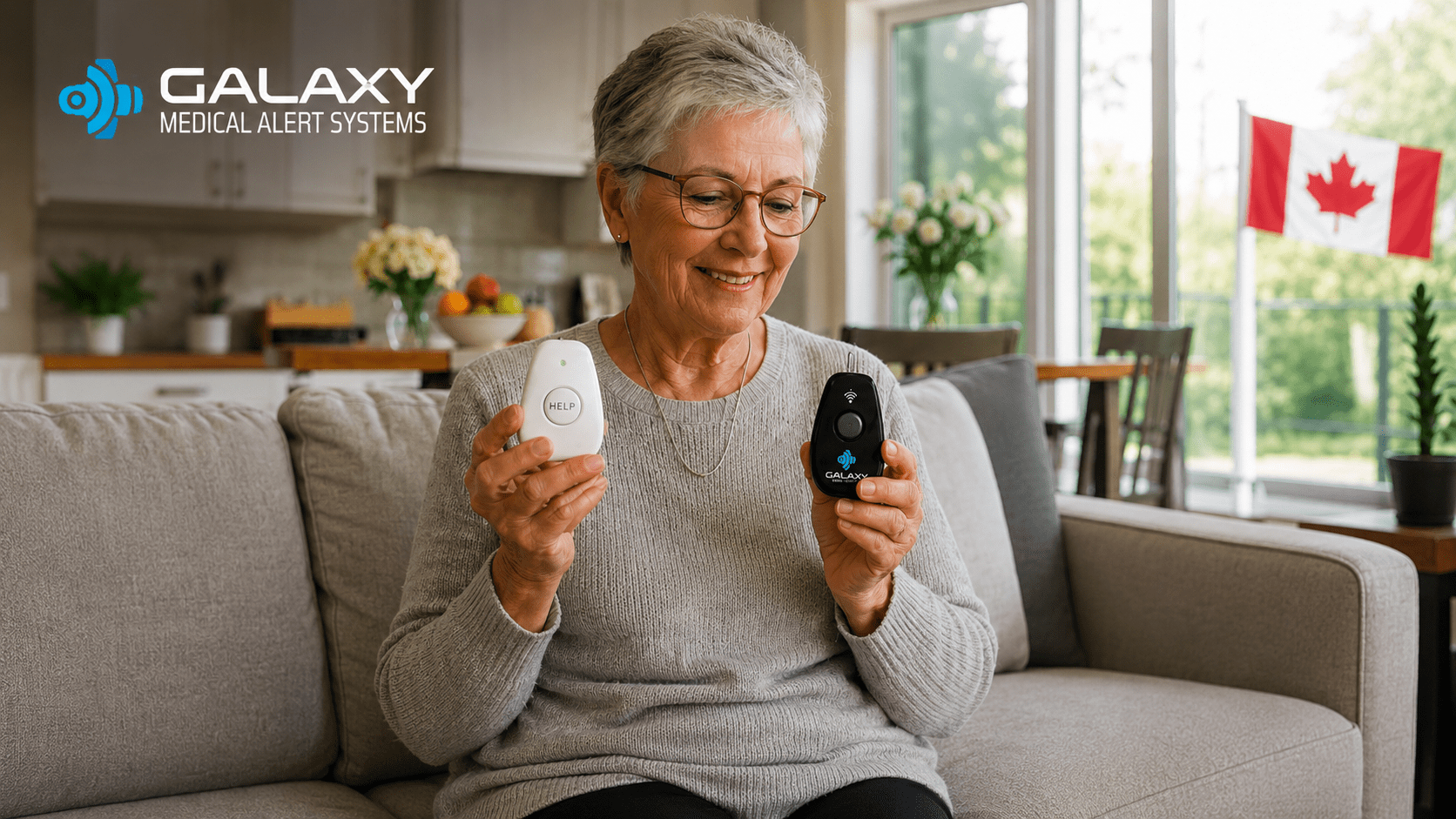
Not sure which Galaxy system fits your situation?
Galaxy Medical Alert Systems has a Help Me Choose tool that helps compare options based on daily routine, mobility, location needs, fall risk, and how help may be needed.
| Help Me Choose a System | Call 1-855-905-7414 |
The Life Alert name gets used by two different companies in Canada
The original Life Alert is a well-known American company, founded in California in 1987. Its “I’ve fallen and I can’t get up” commercials made it famous across North America. Life Alert’s own website does not list Canadian pricing or confirm Canadian service. Its mobile device runs on U.S. cellular coverage. The company itself states plainly that “service may not be available in all areas.” Nothing on Life Alert’s own site confirms that a Canadian resident can actually sign up as a customer.
At the same time, a website called Life Alert Canada ranks well for Canadian searches. It is not the same company. Its own homepage says, in plain text, that it is “an independent site and NOT affiliated with Life Alert® in USA.” It adds that it is “not connected to Life Alert®.” It describes itself as an independent Canadian information source, not a division or licensee of the U.S. brand.
So a Canadian family searching “Life Alert” is really choosing between two different things. One is the real, decades-old U.S. brand that is not clearly set up to serve Canadian customers. The other is an unrelated Canadian business using a similar name for marketing purposes. Neither fact is a criticism of either company on its own. It is simply worth knowing before you compare a price quote. A quote from an independent Canadian site is not a Life Alert® price at all.
Life Alert vs Galaxy: what the original Life Alert actually costs
SafeHome.org, an independent review site, purchased a Life Alert system directly and published its findings in July 2026. According to that review, Life Alert’s plans range from $49.95 to $89.85 per month in U.S. dollars. However, the entry-level plan requires at least one add-on device. In practice, pricing starts closer to $69.95 a month. On top of that, Life Alert charges a one-time fee of about $197 to $198. That fee covers shipping, installation, and activation.
Every Life Alert plan requires a 36-month contract. According to SafeHome.org’s review, the agreement can only end early in specific cases. Those cases are the subscriber dying at home, or moving into a nursing facility or 24-hour professional care with documentation. There is no simple month-to-month opt-out described in that review.
Perhaps the most significant gap for families comparing options today: Life Alert still does not offer automatic fall detection on any plan, in the U.S. or otherwise. Every Life Alert activation depends on a person being conscious and able to press a button.
What Galaxy Medical Alert costs in Canada
Galaxy Medical Alert Systems is a Canadian provider, monitored through a CSAA Diamond-certified response centre. Its Home Cellular System starts at just $34.95 a month. That sits well below what Life Alert charges for a comparable monitored plan. Adding automatic fall detection brings that same in-home system to $44.95 a month. Mobile GPS systems start at $49.95 a month, and fall detection comes standard rather than as an upsell.
Every Galaxy plan includes the equipment, shipping, a lock box for first responders, and a paramedic fridge magnet at no extra charge. There is no separate activation fee. According to Galaxy’s own Terms and Conditions, the initial service term is three months. After that, the plan renews automatically. Either side can give 30 days’ written notice to end it. There is no multi-year lock-in contract.
Life Alert vs Galaxy: side-by-side comparison
| Feature | Life Alert (U.S.) | Galaxy Medical Alert (Canada) |
|---|---|---|
| Starting monthly cost | $69.95 (effective entry price) | $34.95 |
| Activation or setup fee | About $197 to $198, one-time | None |
| Contract length | 36-month agreement | 3-month initial term, then auto-renews |
| Automatic fall detection | Not offered on any plan | Available from $44.95/month; standard on mobile GPS |
| Confirmed Canadian service | Not established on Life Alert’s own site | Yes, Canadian company and monitoring |
| Mobile GPS option | Yes, bundled with in-home plan, $89.95/month | Yes, from $49.95/month, fall detection included |
Life Alert figures reflect SafeHome.org’s independent July 2026 review and Life Alert’s own published terms. Galaxy figures reflect Galaxy’s product pages as of July 2026. Prices and terms can change; confirm current rates directly with either provider before deciding.
The fall detection gap
Fall detection is where the comparison gets the most practical for families. SafeHome.org’s review asked Life Alert directly whether any plan includes automatic fall detection. The answer was no. Every Life Alert customer depends entirely on being able to reach and press a help button after a fall.
Galaxy’s Home Cellular System with Fall Detection and every mobile GPS system include automatic fall detection as part of the plan. It is not a hard-to-find upsell. It is worth being clear about the limits here too. Fall detection is an added layer of protection, not a guarantee. It does not catch every fall. Results depend on the device being worn correctly and charged. Pressing the button whenever possible remains the most reliable way to get help quickly.
Three-year contract vs three-month term
Anyone comparing Life Alert vs Galaxy on paper alone can miss this part. Contract length rarely gets top billing in medical alert marketing. But it shapes the real cost of a mistake. Say a Life Alert customer’s needs change six months in, perhaps a move into assisted living that does not meet the documented exception. They are still bound to a 36-month agreement, with no simple monthly exit described in Life Alert’s own terms.
Galaxy’s structure works differently. The initial term is three months. After that, families can cancel with 30 days’ written notice at any renewal point. Prepaid fees are refunded if the equipment is returned within 90 days. A parent’s health and living situation can change quickly. That flexibility matters as much as the sticker price.
Which one fits a Canadian family’s situation
If brand recognition from decades of television advertising is the deciding factor, Life Alert carries that history. However, its own website gives no clear path for a Canadian resident to actually become a customer. If you found a sign-up option through a Canadian-facing site, that company may not be Life Alert at all.
For a Canadian family that wants confirmed local service and built-in fall detection, Galaxy is the more direct option today. It also comes with a lower starting price and a contract that does not lock in for three years. It is worth comparing both against other Canadian-based providers before deciding. Life Alert vs Galaxy is only one comparison among several worth making.
Ready to compare systems side by side?
Galaxy Medical Alert Systems has a Help Me Choose tool that helps compare options based on daily routine, mobility, location needs, fall risk, and how help may be needed.
| Help Me Choose a System | Call 1-855-905-7414 |
Frequently asked questions
Life Alert vs Galaxy: is Life Alert even available in Canada?
Life Alert’s own website does not confirm Canadian service or list Canadian pricing. Its mobile device relies on U.S. cellular coverage, and the company states that service may not be available in all areas. There is no clear sign-up path for Canadian residents on Life Alert’s official site.
Is “Life Alert Canada” the same company as the original Life Alert?
No. The website lifealertcanada.com says directly, on its own homepage, that it is independent and not affiliated with Life Alert® in the U.S. It is a separate Canadian business using a similar name.
How much does Life Alert cost compared to Galaxy Medical Alert?
Life Alert’s plans effectively start around $69.95 a month. Add a one-time fee near $197, based on SafeHome.org’s July 2026 review. Galaxy’s Home Cellular System starts at $34.95 a month with no activation fee.
Does Life Alert offer automatic fall detection?
No. According to SafeHome.org’s review, Life Alert does not offer automatic fall detection on any of its plans. Users must press a button to call for help.
Does Galaxy Medical Alert require a long-term contract?
No. Galaxy’s initial term is three months. It then renews automatically unless either party gives 30 days’ written notice. There is no multi-year lock-in.
Which is cheaper, Life Alert or Galaxy Medical Alert?
Galaxy is less expensive at every comparable tier. Its base in-home plan starts at $34.95 a month, versus an effective $69.95 a month for Life Alert. Galaxy also does not charge a separate activation fee.
Where is Galaxy Medical Alert’s monitoring based?
Galaxy is a Canadian company, monitored through a CSAA Diamond-certified response centre. Confirm current monitoring details directly with Galaxy if that matters to your decision.
Keep reading
- Medical Alert System for a Parent Living Alone. How to choose the right system and start the conversation about accepting one.
- Medical Alert System Cost in Canada: What You’ll Actually Pay in 2026. A full breakdown of monthly rates, setup fees, and contract terms.
- Is a Medical Alert System Covered by Provincial Health Plans in Canada? What each province actually pays toward the monthly cost.
- Medical Alert Systems in British Columbia: What Families Should Know. Coverage, cost, and cellular vs. landline options for BC families.
- What Is the Golden Hour and Why It Matters After a Fall. Why response time after a fall matters so much.
- How Medical Alert Fall Detection Really Works (and What It Can’t Do). How automatic fall detection technology actually works, and where it falls short.
- Medical Alert Watch vs. Pendant: Which Is Right for Your Parent?
- Is Life Alert Available in Canada? Here’s What Canadians Actually Use
- Medical Alert Systems in Newfoundland & Labrador: What Families Should Know
Important disclaimer
This article is provided for general information only. It is not medical advice, legal advice, emergency advice, or a substitute for speaking with a qualified health care provider, emergency service, or professional advisor. A medical alert system can support an aging-at-home or personal safety plan, but it does not prevent falls, medical events, injuries, wandering, hospitalization, or emergencies. Fall detection features are an added layer of protection and are not guaranteed to detect every fall. GPS features may depend on signal, device function, location, setup, battery status, and other technical or environmental factors. Users should press the help button whenever they are able.
Pricing, plans, and promotions mentioned in this article reflect what was published on galaxymedicalalert.com at the time of writing and may change, be discontinued, or display differently since publication. Always confirm current pricing directly with Galaxy Medical Alert Systems before purchasing.
If someone is experiencing a medical emergency, call 911 or local emergency services immediately.
Sources: SafeHome.org, Life Alert Medical Alert System Review, Cost and Pricing in 2026 (updated July 7, 2026); Life Alert Emergency Response, Inc., lifealert.com (accessed July 2026); lifealertcanada.com (accessed July 2026); Galaxy Medical Alert Systems product and pricing pages, galaxymedicalalert.com; Galaxy Medical Alert Systems Terms and Conditions, galaxymedicalalert.com/terms-conditions/.

 All prices are in Canadian funds.