

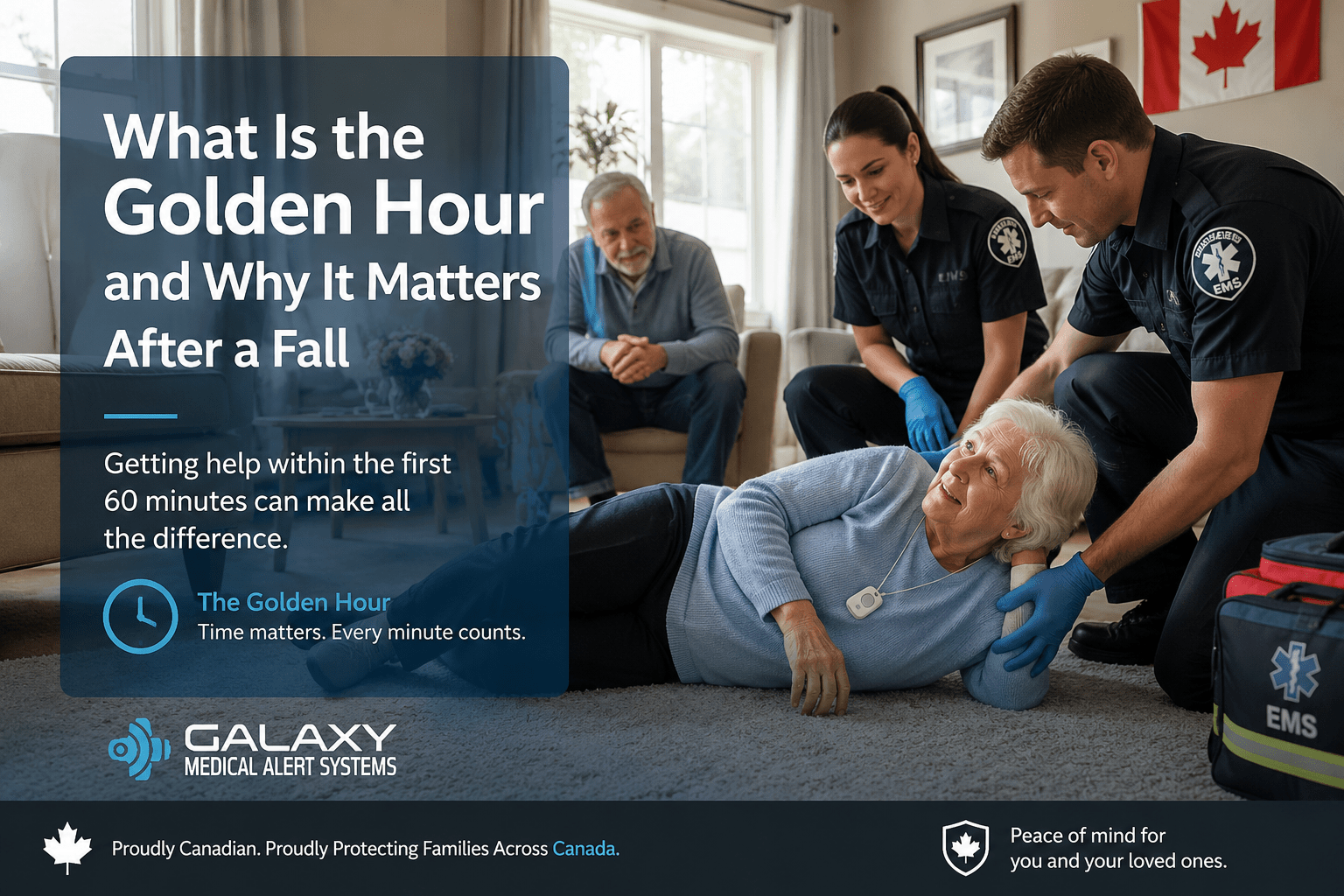
The golden hour fall concept comes from trauma medicine, not fall-specific research. It refers to the idea that how quickly an injured person gets help in the first hour significantly affects their outcome. For seniors who fall and cannot get up, the same principle applies differently. The longer someone lies on the floor before help arrives, the worse their odds become, even without a direct injury from the fall itself.
Not sure which Galaxy system fits your parent?
Galaxy Medical Alert Systems has a Help Me Choose tool that helps families compare options based on the person’s needs, routine and level of independence.
| Help Me Choose a System | Call 1-855-905-7414 |
Where the golden hour fall concept actually comes from
The term traces back to Dr. R Adams Cowley, a trauma surgeon who founded the Shock Trauma Center at the University of Maryland. He popularized it in the 1970s to describe the critical window for treating major trauma, like severe injuries from a car accident. It was never a falls-specific concept. Caregiving and medical alert companies, Galaxy included, later adopted the same principle for seniors who fall. Faster help tends to mean a better outcome. It is worth being precise here. Some marketing treats “the golden hour” as an exact, scientifically proven 60-minute cutoff. A 2001 review in Academic Emergency Medicine found no hard evidence for a strict one-hour threshold. The honest version is simpler: faster response is better, and the first hour is where that difference tends to matter most.
Golden hour fall risk: what actually happens during a long lie
Researchers call it a “long lie”: someone falls, cannot get back up, and no one finds them for an extended period. A landmark study published in the BMJ in 2008 followed people over 90 living at home. About 1 in 5 who fell experienced a long lie of an hour or more. Among those unable to get up for over an hour, half died within six months. This held true even when the fall itself caused no serious injury. The floor time itself, through dehydration, pressure injuries and shock, becomes part of the harm.
That study looked specifically at people over 90 in the UK, so the exact numbers will not apply to every senior. But the underlying pattern holds across the research. The longer someone is down and undiscovered, the more the risk compounds, separate from whatever injury the fall caused.
Why response time matters more for falls specifically
Falls are the leading cause of injury-related hospitalization for Canadians 65 and older. Nationally, they account for 89% of injury-related hospital stays in this age group, according to the Public Health Agency of Canada. Unlike many medical emergencies, a fall often leaves someone conscious but unable to move. That is exactly the scenario where being found quickly matters most. Galaxy states on its own site that getting help within an hour of an emergency gives a person a strong chance of maintaining their independence afterward. That is Galaxy’s own view, not an independently published statistic. It lines up, though, with the direction of the published research above.
How a medical alert system shortens the golden hour fall window
A monitored medical alert system exists to close the gap between falling and getting help. Pressing the button, or triggering automatic fall detection on systems that include it, connects a person to a monitoring centre in seconds rather than waiting for someone to check in or notice they are missing. That is the entire value proposition: not preventing the fall, but shrinking the long lie.
It is worth being honest about the limits here too. Fall detection is an added layer of protection, not a guarantee. It does not catch every fall. Results depend on the device being worn, charged and within range. A system only helps if the person presses the button or the fall-detection sensor triggers correctly, which is why device fit and comfort matter as much as the technology itself.
What this means for your decision
The golden hour is a real principle borrowed from trauma medicine, not a falls-specific scientific threshold. It is worth using it that way, not as a marketing absolute. What the actual research shows is narrower but still compelling: for seniors who cannot get up after a fall, time on the floor is itself a risk, separate from the injury. A medical alert system’s job is to shrink that time. The monthly cost either makes sense or it does not, and that depends on how long your parent would otherwise go unnoticed after a fall today.
Frequently asked questions
Is the golden hour a real medical term?
Yes, but it originated in trauma medicine for major injuries like car accidents, not falls specifically. Caregiving and medical alert companies later adopted the same principle for seniors: faster help after a fall tends to mean a better outcome. Peer-reviewed research has questioned a strict 60-minute cutoff. It is best understood as a general principle, not an exact threshold.
What happens if a senior falls and cannot get up?
Research published in the BMJ found that among people over 90 who experienced a “long lie” of more than an hour after a fall, half died within six months, even without a serious injury from the fall itself. The time spent on the floor, not just the fall, carries real risk.
Does fall detection guarantee help within the golden hour?
No. Fall detection is an added layer of protection, not a guarantee. It does not catch every fall and depends on the device being worn and charged. Pressing the help button remains the most reliable way to get help quickly.
How much does a medical alert system cost?
Galaxy’s monitored plans start at just $34.95 a month, with fall detection and GPS available as add-ons. See our full cost breakdown for setup fees and contract terms.
What if my parent lives alone and is at risk of a long lie?
Our guide on choosing a medical alert system for a parent living alone covers how to think through device fit and the conversation around accepting one.
Keep reading
- Medical Alert System for a Parent Living Alone — how to choose the right system and start the conversation about accepting one.
- Is a Medical Alert System Covered by Provincial Health Plans in Canada? — what each province actually pays toward the monthly cost.
- Medical Alert System Cost in Canada: What You’ll Actually Pay in 2026 — a full breakdown of monthly rates, setup fees and contract terms.
- Medical Alert Systems in British Columbia: What Families Should Know — coverage, cost and cellular vs. landline options for BC families.
- Medical Alert Systems in Newfoundland & Labrador: What Families Should Know — coverage, cost and rural cellular coverage for NL families.
- Medical Alert Watch vs. Pendant: Which Is Right for Your Parent?
- Is Life Alert Available in Canada? Here’s What Canadians Actually Use
- How Medical Alert Fall Detection Really Works (and What It Can’t Do)
- Life Alert vs. Galaxy Medical Alert: How Canadian Options Compare
Important disclaimer
This article is provided for general information only. It is not medical advice, legal advice, financial or tax advice, or a substitute for speaking with a qualified health care provider, government program office, benefits administrator, or professional advisor. Program details, funding amounts and eligibility rules described here reflect publicly available information as of July 2026 and can change; confirm current details directly with the relevant provincial, federal, or Veterans Affairs Canada program before relying on them.
A medical alert system can support an aging-at-home or personal safety plan, but it does not prevent falls, medical events, injuries, wandering, hospitalization, or emergencies. Fall detection features are an added layer of protection and are not guaranteed to detect every fall. GPS features may depend on signal, device function, location, setup, battery status, and other technical or environmental factors. Users should press the help button whenever they are able.
If someone is experiencing a medical emergency, call 911 or local emergency services immediately.
Pricing, plans, and promotions mentioned in this article reflect what was published on galaxymedicalalert.com at the time of writing and may change, be discontinued, or display differently since publication. Always confirm current pricing directly with Galaxy Medical Alert Systems before purchasing.

 All prices are in Canadian funds.