

When Mom or Dad Lives Alone and You Live Out of Town: Choosing a Medical Alert System for a Parent Living Alone
If you are searching for a medical alert system for a parent living alone, you are probably not doing it casually. You may be worried because Mom or Dad lives in Windsor, London, Hamilton or another Ontario community, while you live in a different city and cannot check in every day.
It usually starts with a small warning sign.
Mom did not answer the phone one evening. Dad slipped in the bathroom but said he was “fine.” A neighbour called because the newspaper was still outside. A sibling dropped in and noticed that getting up from a chair was harder than it used to be.
For adult children who live out of town, these moments create a difficult question:
How do you help an aging parent stay independent at home when you cannot be there every day?
For many families in Windsor, London, Hamilton and other Ontario communities, a medical alert system becomes one of the first practical steps. It does not replace family, home care, medical treatment or good planning. It gives your parent a direct way to call for help if something happens and they cannot easily reach the phone.
That matters when a parent lives alone.
Not sure which Galaxy system fits your parent?
Galaxy Medical Alert Systems has a Help Me Choose tool that helps families compare options based on the person’s needs, routine and level of independence.
| Help Me Choose a System | Call 1-855-905-7414 |
Peace of mind before there is an incident
Many families wait until after a fall, a hospital visit, or a frightening missed call before putting a safety plan in place. A medical alert system is often most useful before that moment. It gives your parent a way to call for help quickly and gives your family a clearer response plan while your parent is still living independently.
Why this decision feels different when you live out of town
When you live nearby, you may be able to check in after work, stop by after a doctor’s appointment, or respond quickly if something feels wrong.
When you live in another city, the distance changes everything.
You may still be the main decision-maker. You may still be the person Mom or Dad trusts most. But you are relying on phone calls, neighbours, siblings, occasional visits and your parent’s own willingness to report what is really happening.
That can create a false sense of reassurance.
Many older adults minimize falls, dizziness, confusion, fatigue or near-misses because they do not want to worry their children. Others worry that admitting a problem will lead to pressure to move. Some simply believe they can manage because they have always managed.
A medical alert system can help bridge that gap. It gives your parent a way to ask for help quickly, while giving the family a clearer safety plan.
How to choose a medical alert system for a parent living alone
A medical alert system, sometimes called a personal emergency response system, gives a person access to help through a wearable button, pendant, bracelet, watch, mobile device or in-home base unit.
The basic idea is simple. If your parent needs help, they press the button. Depending on the system, they may be connected through two-way voice communication to a response centre. A designated family contact, neighbour, emergency medical services or fire rescue may be contacted based on the situation and the response plan.
Some systems are designed mainly for use inside the home. Others include mobile GPS features for people who go outside, walk in the neighbourhood, drive, shop, attend appointments or travel.
For an out-of-town adult child, the key issue is not just the device. It is the response process behind the device.
Why falls are such a serious concern for older adults living alone
Falls are one of the main reasons families begin looking for a medical alert system for a parent living alone.
According to the Public Health Agency of Canada’s most recent national fall data, published in November 2025, falls remain a major health risk for older adults. In Canada, 7,621 adults aged 65 and older died from falls in 2022, and 78,076 fall-related hospitalizations were recorded among adults 65 and older in 2022, excluding Quebec. Falls account for 89% of injury-related hospitalizations in this age group, and fall-related hospital stays typically last 9 days longer than the average hospital stay for older adults.
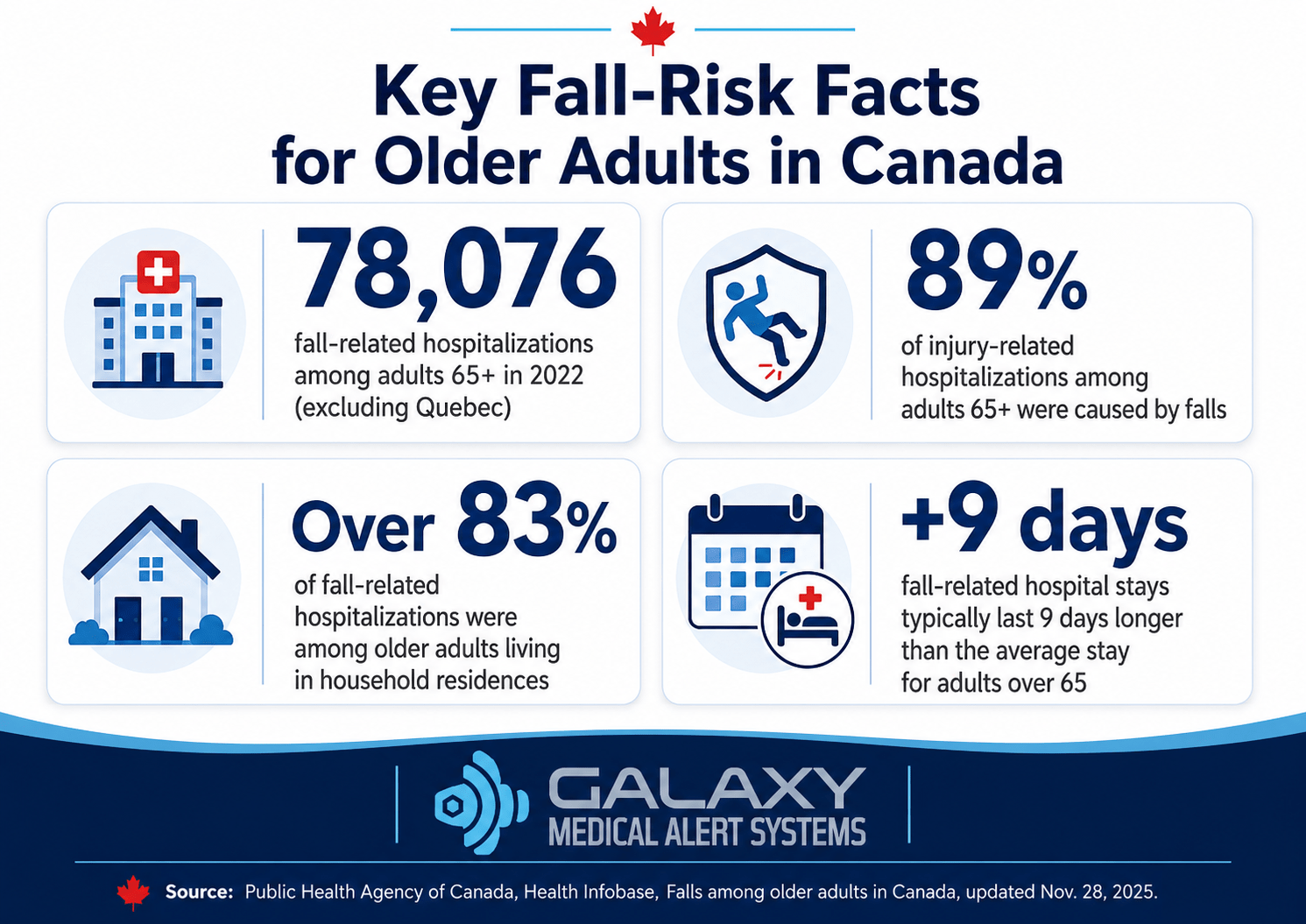
Over 83% of these fall-related hospitalizations involved older adults living in a household residence, not a hospital or care facility. That is the exact living situation this guide is about.
This does not mean every older adult who lives alone is unsafe. It means families should take warning signs seriously.
A fall can be more than a single event. It can lead to fear, reduced mobility, hospitalization, loss of confidence and pressure to consider assisted living, retirement living or long-term care sooner than expected.
The goal is not to frighten your parent. The goal is to plan before a crisis forces decisions.
Home medical alert system or mobile GPS device?
The right system depends on your parent’s real routine.
Some parents spend most of their time at home. They may go out only with family, a driver, a neighbour or a home care worker. In that case, an in-home medical alert system may be the right starting point.
A home medical alert system may be suitable when:
- Your parent lives alone in a house, condo or apartment.
- They are mostly at home.
- They want something simple.
- They are not comfortable using a smartphone.
- They need a button they can wear around the house.
- The main concern is a fall, medical episode or emergency inside the home.
Galaxy’s in-home options include home medical alert systems, cellular options, emergency buttons, 24/7 monitoring and fall detection options. Families can review Galaxy’s In the Home Medical Alert Systems to compare options.
A mobile GPS medical alert system may be better when your parent is still active outside the home.
A mobile GPS system may be suitable when:
- Your parent walks outside alone.
- They still drive.
- They shop, attend appointments or visit friends.
- They may not always know or explain their exact location during an emergency.
- Family wants protection both at home and away from home.
- They are comfortable wearing a watch, pendant, lanyard or belt-style device.
Galaxy’s mobile options include GPS, fall detection, mobile watches, mobile pendants, Wi-Fi calling options on select devices, two-way voice communication and 24/7 monitoring. Families can review Galaxy’s On the Go Medical Alert Systems to compare mobile options.
The practical question is this:
Does your parent mostly need help at home, or do they need help wherever they are?
Home medical alert vs mobile GPS medical alert
| Question | Home Medical Alert System | Mobile GPS Medical Alert System |
|---|---|---|
| Best for | A parent who is mostly at home | A parent who leaves home independently |
| Typical device | Base unit with pendant or bracelet | Watch, pendant, lanyard or mobile device |
| Location support | Primarily for use inside or around the home | GPS location support for emergencies away from home |
| Good fit when | The main concern is a fall or medical emergency at home | The parent walks, shops, drives or attends appointments alone |
| Family concern | “What if something happens at home and they cannot reach the phone?” | “What if something happens while they are away from home?” |
Is fall detection worth considering?
Fall detection is worth considering when your parent has a fall history, balance concerns, dizziness, mobility changes, medication changes, Parkinson’s disease, post-surgery weakness, frailty, or a pattern of not wanting to “make a fuss.”
Fall detection is designed to help when a fall may prevent someone from pressing the button manually.
It should still be explained carefully. No fall detection technology can guarantee that every fall will be detected. Galaxy notes that fall detection will not detect 100% of all falls and that users should press the button whenever they are able.
Families should treat fall detection as an added layer of protection, not a perfect substitute for wearing the device properly, pressing the button when able, and having a broader safety plan.
For many out-of-town adult children, that extra layer may still be important.
Windsor, London and Hamilton families may have different local considerations
The device decision is similar across Ontario, but the local situation can differ.
Medical alert systems in Windsor, Ontario
Galaxy Medical Alert Systems is based in Windsor and serves customers across Canada and the United States. For Windsor and Essex County families, that local connection may help build trust, especially when an adult child is trying to arrange support for a parent from another city.
Windsor families may be searching after a parent has started living alone, after a fall, after a health change, or after family members notice that the parent is becoming less confident at home.
For a parent who mostly stays home, an in-home cellular system with fall detection may be appropriate. For a parent who still goes out independently, a mobile GPS system or watch may be a better fit.
Medical alert systems in London, Ontario
London families may come across hospital-connected, community-connected or private medical alert options when researching support for a parent. Those services may be worth reviewing, especially if a parent is already connected to local health services.
The comparison should be practical. Does the system work at home only, or also outside? Does it require a landline? Is fall detection available? Is GPS available? Can family members be part of the response plan? What are the fees, contract terms, setup requirements and cancellation policies?
If your parent lives in London but you live elsewhere, the best system is the one your parent will actually wear and use.
Medical alert systems in Hamilton, Ontario
Hamilton is a competitive search area for medical alert systems, with several providers promoting local or Ontario-wide service.
Families should avoid choosing based only on the first ad or first search result. Compare the actual features:
- Is there 24/7 monitoring?
- Is there two-way voice communication?
- Are fall detection and GPS available?
- Does the system require a landline?
- Is the device water-resistant?
- Can emergency contacts be customized?
- Are there long-term contracts, activation fees or equipment fees?
- Is the system simple enough for your parent to use every day?
For Hamilton families, the right decision is less about the city name on the page and more about whether the system fits your parent’s actual living pattern.
A practical checklist for out-of-town adult children
| What to compare | Why it matters |
|---|---|
| Home vs mobile protection | A parent who rarely leaves home may need a different system than one who walks, shops or drives. |
| Fall detection | Useful when a parent may not be able to press the button after a fall. |
| GPS location | Important for active seniors who may need help away from home. |
| Landline requirements | Many homes no longer have traditional landlines. Cellular options may be easier. |
| Two-way voice | Allows the response centre to speak directly with the user when possible. |
| Response plan | Families should know who is called, in what order, and when EMS or fire rescue may be dispatched. |
| Ease of setup | A simple system matters when family cannot be there in person. |
| Wearing comfort | The best device is the one your parent will actually wear. |
| Monthly cost | Compare monthly fees, activation fees, equipment fees and cancellation terms. |
| Family peace of mind | The system should support independence, not make your parent feel watched or controlled. |
How to talk to your parent about a medical alert system
Many parents resist the idea at first.
That resistance is understandable. A medical alert device can feel like a symbol of aging, vulnerability or loss of independence. If the conversation starts with fear, it may not go well.
A better approach is to frame the system as a way to stay independent.
“I know you want to stay in your own home. I want that too. Since I’m not close by, I would feel better if you had a simple way to get help quickly if something happened.”
“This is not about taking anything away from you. It is about making sure one bad moment does not turn into a bigger crisis.”
The tone matters. You are not trying to win an argument. You are trying to build a shared safety plan.
Where Galaxy Medical Alert fits
Galaxy Medical Alert Systems offers medical alert products for people who live alone, want to remain independent, or need a reliable way to reach help during an emergency.
Families can compare in-home systems, in-home systems with fall detection, mobile GPS systems, medical alert watches, mobile pendants and systems with Wi-Fi calling options.
Galaxy also offers 24/7 monitoring, two-way voice communication, fall detection options, GPS location services on mobile systems, no-landline cellular options, and a Help Me Choose tool for families who are not sure which system fits.
For adult children, one important detail is that Galaxy states that service can be ordered for someone else, such as a parent, and billed to the adult child’s credit card. That can be helpful when the adult child is arranging protection from another city.
If Mom or Dad lives alone in Windsor, London, Hamilton or another Ontario community, the starting point is not to buy the most advanced device. The starting point is to match the system to their real life.
- Are they mostly at home?
- Do they go out alone?
- Have they fallen before?
- Would they wear a pendant?
- Would they prefer a watch?
- Do they need fall detection?
- Would GPS location help if they had an emergency away from home?
- Would they be more comfortable with a simple in-home button?
Those questions matter more than product names.
Compare Galaxy options for your parent
| Parent’s situation | Galaxy option to review | Best next step |
|---|---|---|
| Mostly at home, lives alone, wants simple protection | In the Home Medical Alert | Review home cellular options |
| Mostly at home, has fall risk or balance concerns | Home Cellular System with Fall Detection | Compare fall detection features |
| Still active outside the home | On the Go Medical Alert | Review GPS-enabled systems |
| Prefers a watch-style device | Mobile Watch System with GPS and Fall Protection | Check comfort and charging needs |
| Family is unsure which system fits | Help Me Choose | Answer a few quick questions online |
A medical alert system is not the whole safety plan
A medical alert system should be part of a broader aging-at-home plan.
Families should also look at:
- Bathroom safety.
- Stair and railing safety.
- Medication management.
- Vision and hearing changes.
- Footwear.
- Lighting.
- Trip hazards.
- Emergency contact lists.
- Neighbour check-ins.
- Home care, if needed.
- Medical follow-up after a fall or near-fall.
The device helps with emergency access. It does not remove every risk.
That is exactly why it can be such a useful first step. It is practical, relatively quick to arrange, and often easier to discuss than moving, selling the home or hiring daily support.
When should you act?
Do not wait for the “big fall” before having the conversation.
Consider a medical alert system if your parent:
- Lives alone.
- Has fallen or nearly fallen.
- Has trouble getting up from a chair.
- Uses a cane, walker or mobility aid.
- Has dizziness, weakness or balance concerns.
- Has recently returned home from hospital.
- Has a medical condition that could create sudden risk.
- Is widowed or newly alone at home.
- Does not carry a phone consistently.
- Has family who live out of town.
If one or two of these apply, it may be time to compare options.
Need help choosing a medical alert system for a parent living alone?
If your parent lives alone in Windsor, London, Hamilton or another Ontario community, Galaxy can help you compare home systems, fall detection, mobile GPS devices and watch-style options.
| Use Help Me Choose | Contact Galaxy |
Prefer to speak with someone? Call 1-855-905-7414.
Final thought for adult children
The goal is not to make your parent feel old.
The goal is to make sure help is available if something happens when no one else is there.
For families in Windsor, London and Hamilton, a medical alert system can be a reasonable, practical safety layer for a parent who wants to remain at home. It can help protect independence while giving family members a clearer response plan.
If you are not sure which system fits your parent, start with Galaxy’s Help Me Choose tool or call Galaxy Medical Alert Systems at 1-855-905-7414.
Frequently asked questions
What is the best medical alert system for a parent living alone?
The best system depends on how your parent lives. If they are mostly at home, an in-home medical alert system may be enough. If they leave home alone, a mobile GPS system or medical alert watch may be more appropriate. Fall detection may be important if they have balance concerns or a history of falls.
Should my parent choose a pendant or a watch?
Choose the device your parent is most likely to wear. Some older adults prefer a pendant because it is simple. Others prefer a watch because it feels more familiar or less noticeable. The right choice is the one that stays on the body during daily routines.
Does a medical alert system require a landline?
Not always. Many modern medical alert systems use cellular technology. Galaxy offers home cellular and mobile systems that do not require a traditional landline.
Is fall detection guaranteed to detect every fall?
No. Fall detection is an added safety feature, not a guarantee. It can be valuable when someone may not be able to press a button after a fall, but users should still press the help button whenever they are able.
Can I order a medical alert system for my parent?
Yes. Galaxy states that service can be ordered for someone else, such as a parent, and billed to the adult child’s credit card. This can be helpful when a parent lives in Windsor, London, Hamilton or another city while family lives elsewhere.
What should I compare before choosing a medical alert provider?
Families should compare home versus mobile protection, fall detection, GPS location, landline requirements, two-way voice communication, response centre support, ease of setup, contract terms, monthly costs and whether family contacts can be included in the response plan.
Is a medical alert system useful if my parent still drives or goes out alone?
Yes, but the system should match that routine. A parent who still drives, walks, shops or attends appointments alone may benefit from a mobile GPS medical alert device rather than a home-only system.
What is the best medical alert system in Windsor, London or Hamilton?
The best medical alert system is the one that fits the parent’s daily routine, health risks and comfort level. Families in Windsor, London and Hamilton should compare home systems, fall detection, GPS support, 24/7 monitoring, setup requirements, fees and whether the parent will actually wear the device.
Keep reading
- Is a Medical Alert System Covered by Provincial Health Plans in Canada? — what each province actually pays toward the monthly cost.
- Medical Alert System Cost in Canada: What You’ll Actually Pay in 2026 — a full breakdown of monthly rates, setup fees and contract terms.
- Medical Alert Systems in British Columbia: What Families Should Know — coverage, cost and cellular vs. landline options for BC families.
- Medical Alert Watch vs. Pendant: Which Is Right for Your Parent?
- Is Life Alert Available in Canada? Here’s What Canadians Actually Use
- How Medical Alert Fall Detection Really Works (and What It Can’t Do)
- Life Alert vs. Galaxy Medical Alert: How Canadian Options Compare
- What Is the Golden Hour and Why It Matters After a Fall
- Medical Alert Systems in Newfoundland & Labrador: What Families Should Know
Important disclaimer
This article is provided for general information only. It is not medical advice, legal advice, emergency advice, or a substitute for speaking with a qualified health care provider, emergency service, or professional advisor.
A medical alert system can support an aging-at-home safety plan, but it does not prevent falls, medical events, injuries, hospitalization, or emergencies. Fall detection features are an added layer of protection and are not guaranteed to detect every fall. Users should press the help button whenever they are able.
Device performance may depend on proper setup, regular use, battery status, cellular or Wi-Fi signal, GPS availability, user location, and other technical or environmental factors. Families should review product details, service terms, monitoring procedures, emergency contact plans, pricing, and cancellation policies directly with Galaxy Medical Alert Systems before choosing a system.
If someone is experiencing a medical emergency, call 911 or local emergency services immediately.
Pricing, plans, and promotions mentioned in this article reflect what was published on galaxymedicalalert.com at the time of writing and may change, be discontinued, or display differently since publication. Always confirm current pricing directly with Galaxy Medical Alert Systems before purchasing.
Sources and helpful links
- Public Health Agency of Canada: Falls among older adults in Canada, updated November 28, 2025
- Public Health Agency of Canada: Falls Among Older Adults in Canada infographic, 2025
- Galaxy In the Home Medical Alert Systems
- Galaxy On the Go Medical Alert Systems
- Galaxy Help Me Choose Tool
- Galaxy FAQs, Benefits and How it Works
- Contact Galaxy Medical Alert Systems

 All prices are in Canadian funds.