

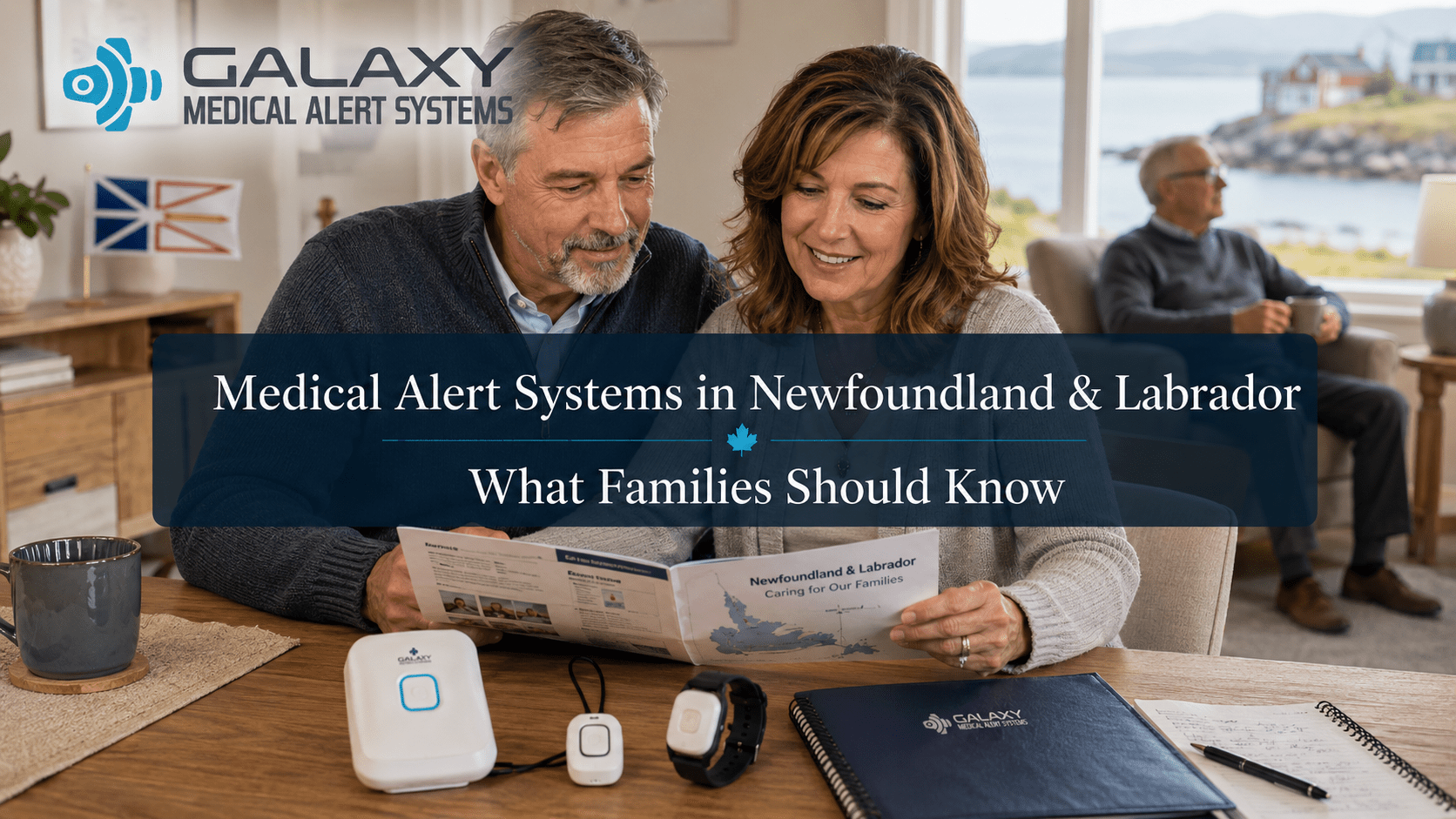
Newfoundland and Labrador holds a distinction no other province has reached yet: it is the oldest population in Canada. One in four residents is now 65 or older, against a national average closer to one in five. That single fact reshapes a lot of decisions for families here. It shapes whether a medical alert system Newfoundland families can rely on justifies the monthly cost. The province usually does not cover it. The real question is what you get for the money, and whether the system works where your parent lives.
Not sure which Galaxy system fits your parent?
Galaxy Medical Alert Systems has a Help Me Choose tool that helps families compare options based on the person’s needs, routine and level of independence.
| Help Me Choose a System | Call 1-855-905-7414 |
How NL became the oldest province in Canada
Statistics Canada puts NL’s share of residents 65 and older at 25.2%, compared with a 19.5% national average, and the province’s median age at 47.8. Younger people have left for work in other provinces for decades, while the people who stayed have aged in place. The Office of the Seniors’ Advocate NL reported in December 2024 that seniors’ wellbeing here lags national averages on several measures. That finding is part of why the province launched new supports the same year.
For families, this is not a fringe question. In NL, it comes up the way it might somewhere with a much younger population. A meaningful share of households in every community are weighing this decision right now, not just in the largest towns.
What NL will and won’t pay toward a medical alert system
Nothing in the province’s core programs funds a personal emergency response device directly. The Provincial Home Support Program pays for personal care, homemaking and respite on an income-tested basis. The Special Assistance Program covers some basic medical equipment for daily living. Personal Care Home subsidies cover accommodation. None of the three programs lists medical alert devices among what they fund. Caseworkers do assess some requests individually, though, so it’s worth asking rather than assuming.
What NL added in 2024 is broader, not device-specific. The Seniors’ Health and Well-Being Plan added three new supports in 2024. The Aging Well at Home Grant pays up to $400 a year for things like snow clearing and grocery delivery. The Caregiver Benefit pays up to $400 a month, and seniors in coastal Labrador also get a $500 annual supplement. None of it pays a monitoring bill directly. But for a household already receiving one of these, it changes what else fits in the monthly budget.
A landline won’t reach most of this province
Picture the distance between St. John’s and a fishing community on the Labrador coast: hundreds of kilometres, often without continuous cellular service along the way. That is the reality a medical alert system has to work inside here, not an edge case. A 2023 federal audit found rural NL has basic cellular coverage across roughly 83% of its territory. Only about 54% has the faster LTE service most modern alert systems need. On First Nations reserves, LTE coverage drops to around 26%.
A cellular-based system solves the landline problem, since it does not need a home phone line at all. It does not solve a dead zone. Families outside St. John’s, Corner Brook and Gander need to ask two things before signing up. Does the system fall back to another network when the primary carrier’s signal is weak? Is coverage confirmed at the exact address, not just the general region?
What a medical alert system costs once coverage is confirmed
A medical alert system Newfoundland families trust has to clear two bars. It must connect from the address, and it must be worth paying for. Once the coverage question is settled, pricing for a medical alert system Newfoundland families choose is straightforward. It does not change by province. Galaxy’s monitored plans start at just $34.95 a month, below what several larger providers charge for a comparable service. Fall detection and GPS are available as add-ons. Our full cost guide for Canada breaks down setup fees and contract terms if you want the full picture first.
The bottom line for NL families
NL’s aging population is not a talking point. It is the reason this decision comes up so often here. The government will not cover the monthly fee. The newer well-being supports are real, but the province didn’t design them around this expense. Two questions actually decide the outcome. Does a medical alert system built for Newfoundland’s geography work at your parent’s specific address? And does the monthly cost buy something genuinely worth having? A quarter of this province’s population is already a senior. That makes this anything but a hypothetical question for most NL families.
Frequently asked questions
Why does Newfoundland and Labrador have so many seniors?
Decades of younger residents leaving for work elsewhere in Canada, combined with the people who stayed aging in place, have made NL the province with the highest share of residents 65 and older: 25.2%, against a 19.5% national average.
Does the NL government cover the cost of a medical alert system?
Not directly. A medical alert system Newfoundland households pay for out of pocket is not covered by any of NL’s core programs. The Provincial Home Support Program, Special Assistance Program and Personal Care Home subsidies all cover other costs. None of them lists medical alert devices among what they fund. Caseworkers do assess some requests case by case, though, so ask directly rather than assume.
What did the 2024 Seniors’ Health and Well-Being Plan actually add?
The 2024 plan added three things. The Aging Well at Home Grant pays up to $400 a year. The Caregiver Benefit pays up to $400 a month, and coastal Labrador seniors get a $500 annual supplement on top. None of it targets a monitoring device directly, but it can offset other costs in the same household budget.
Will a cellular medical alert system work anywhere in Labrador?
Not everywhere. Rural NL has basic cellular coverage across about 83% of its territory. Only around 54% has the faster LTE service most modern systems use. Confirm coverage at the specific address, and ask whether the system falls back to another network where signal is weak.
How much does a medical alert system cost?
Pricing does not change by province. Galaxy’s monitored plans start at $34.95 a month, with fall detection and GPS available as add-ons. See the full cost breakdown for setup fees and contract terms.
Keep reading
- Medical Alert System for a Parent Living Alone. How to choose the right system and start the conversation about accepting one.
- Is a Medical Alert System Covered by Provincial Health Plans in Canada? What each province actually pays toward the monthly cost.
- Medical Alert System Cost in Canada: What You’ll Actually Pay in 2026. A full breakdown of monthly rates, setup fees, and contract terms.
- Medical Alert Systems in British Columbia: What Families Should Know. Coverage, cost, and cellular vs. landline options for BC families.
- What Is the Golden Hour and Why It Matters After a Fall. What the research actually shows about response time after a fall.
- Medical Alert Watch vs. Pendant: Which Is Right for Your Parent?
- Is Life Alert Available in Canada? Here’s What Canadians Actually Use
- How Medical Alert Fall Detection Really Works (and What It Can’t Do)
- Life Alert vs. Galaxy Medical Alert: How Canadian Options Compare
Important disclaimer
This article is provided for general information only. It is not medical advice, legal advice, financial or tax advice, or a substitute for speaking with a qualified health care provider, government program office, benefits administrator, or professional advisor. Program details, funding amounts and eligibility rules described here reflect publicly available information as of July 2026 and can change; confirm current details directly with the relevant provincial, federal, or Veterans Affairs Canada program before relying on them.
A medical alert system can support an aging-at-home or personal safety plan, but it does not prevent falls, medical events, injuries, wandering, hospitalization, or emergencies. Fall detection features are an added layer of protection and are not guaranteed to detect every fall. GPS features may depend on signal, device function, location, setup, battery status, and other technical or environmental factors. Users should press the help button whenever they are able.
If someone is experiencing a medical emergency, call 911 or local emergency services immediately.
Pricing, plans, and promotions mentioned in this article reflect what was published on galaxymedicalalert.com at the time of writing and may change, be discontinued, or display differently since publication. Always confirm current pricing directly with Galaxy Medical Alert Systems before purchasing.

 All prices are in Canadian funds.