

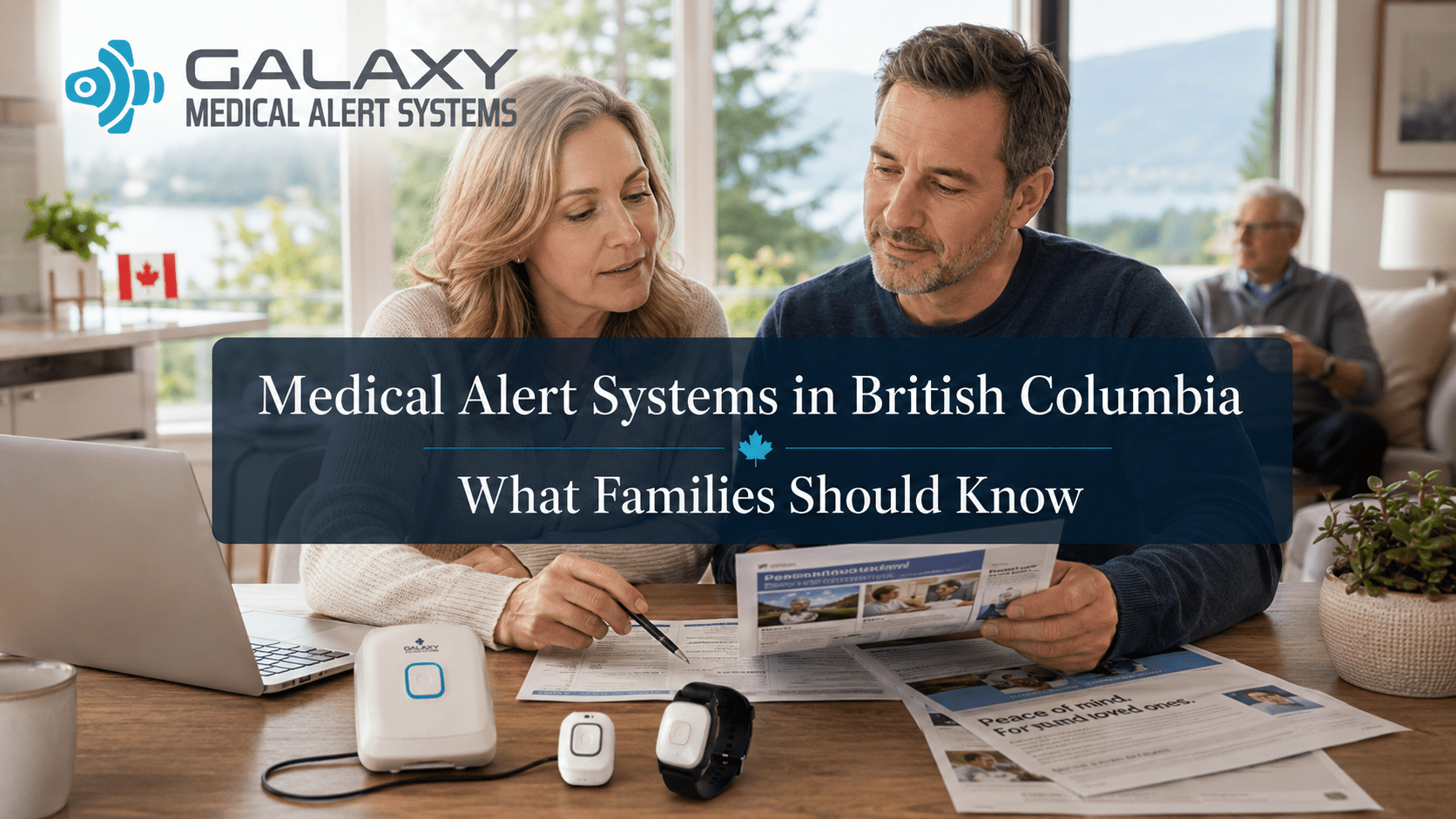
Families researching a medical alert system BC seniors can rely on quickly hit the same wall. The province does not pay the monthly monitoring fee. Regional health authorities such as Island Health and Fraser Health list personal emergency response services as an option for seniors. They warn upfront that monitoring fees apply. BC PharmaCare’s medical supplies coverage extends to items like insulin pumps and ostomy supplies. It does not cover personal alert devices. For families in Victoria, Kelowna, Surrey or anywhere in between, that gap matters. BC hospitals admit an older adult after a fall roughly every 30 minutes.
Not sure which Galaxy system fits your parent?
Galaxy Medical Alert Systems has a Help Me Choose tool that helps families compare options based on the person’s needs, routine and level of independence.
| Help Me Choose a System | Call 1-855-905-7414 |
Falls are common in BC. Here’s why that matters for seniors living alone
Falls are the leading cause of injury-related death and hospitalization for adults 65 and older in British Columbia. The BC Injury Research and Prevention Unit reports that BC hospitals admit an older adult after a fall about every 30 minutes. A fall kills one BC senior every day. Fall-related hospitalizations among BC seniors rose 23% between 2012 and 2022. BCIRPU puts the total 2025 cost of falls among older adults in the province at $1.41 billion. That figure splits into direct health care spending and indirect costs like lost independence and caregiving time.
That is the backdrop families are weighing when they ask whether a monitored alert system is worth the monthly fee. The number by itself does not answer the question. But it explains why the question keeps coming up.
Does BC’s health care system cover a medical alert system?
No, not directly. BC PharmaCare’s medical supplies coverage pays for items such as insulin pumps, ostomy supplies and orthoses. Personal emergency response devices are not on that list. BC Employment and Assistance offers a discretionary provision for people with an imminent, life-threatening health need and no other resources. Caseworkers assess each request individually. It is not a standing medical alert benefit families can count on.
This is a different picture than Alberta. That province’s Special Needs Assistance for Seniors program funds up to $24 a month toward PERS monitoring for qualifying low-income seniors, as we cover in our guide to medical alert system coverage through provincial health plans. BC has no direct equivalent. The BC Senior’s Supplement is a general income top-up, not a device subsidy. It does not change the monthly bill for a specific service.
Island Health’s seniors health and safety page lists Lifeline as an option for families. It says plainly that activation and monitoring fees apply. Fraser Health and Vancouver Coastal Health publish similar guidance. These are services families arrange and pay for directly. The health authority does not fund them.
What it actually costs once coverage questions are settled
Since BC does not subsidize a medical alert system, the real cost comes down to the plan and equipment a family chooses. Galaxy’s base monitored plan starts at just $34.95 a month, below what several larger providers charge for a comparable monitored plan. Optional add-ons like fall detection and GPS cover on-the-go needs. We break down every line item, including setup fees and contract terms, in our full medical alert system cost guide for Canada. The short version: a medical alert system BC families choose usually includes the device, with no separate equipment fee. The monthly fee, not the hardware, is where the real decision gets made.
Cellular coverage for a medical alert system matters more once you leave Metro Vancouver
BC’s population is concentrated but spread across very different geography. Metro Vancouver added 127,680 people between 2023 and 2024, the fastest growth of any region in the province at 4.3%. Surrey alone grew 6.8% to 700,459 residents. Fraser Valley added 9,519 people. The Capital Regional District around Victoria and southern Vancouver Island added 7,282. The Central Okanagan added 4,986, according to BC Stats’ 2024 sub-provincial population estimates.
For a family in the Interior, on Vancouver Island outside Victoria, or in a northern community, a landline-dependent system is a real limitation. A cellular-based medical alert system does not depend on a home phone line at all. That matters in rural BC, where landline service is being phased out or was never reliable to begin with. It is worth confirming cellular coverage at the specific address before choosing a plan. That check matters most for a medical alert system BC residents outside Metro Vancouver depend on. Mountainous terrain can affect signal in parts of the Interior and North.
Where this leaves BC families
British Columbia will not cover the monthly cost of a medical alert system. There is no provincial subsidy comparable to Alberta’s. That leaves the decision where it usually belongs: with the family. A medical alert system BC seniors can count on still needs to clear two bars. Does it work at the address, and is it worth the monthly cost? It comes down to how much independence a parent has, how isolated their home is, and whether cellular coverage reaches their address. The $1.41 billion BC spends on fall-related care each year is a system-level number. But the 30-minutes-between-hospitalizations statistic is the one that tends to change a family’s mind about whether to wait.
Frequently asked questions
Does BC health insurance cover the cost of a medical alert system?
No. BC PharmaCare’s medical supplies coverage does not include personal emergency response devices. Regional health authorities that list services like Lifeline are clear that monitoring fees apply. Families arrange and pay for coverage directly.
Is there a BC subsidy for seniors similar to Alberta’s Special Needs Assistance program?
Not directly. Alberta funds up to $24 a month toward PERS monitoring for qualifying seniors. BC’s closest option is a discretionary, case-by-case provision through BC Employment and Assistance for people with an imminent life-threatening need and no other resources. That is narrower and not guaranteed. The BC Senior’s Supplement is a general income top-up, not a device-specific benefit.
Do I need a landline for a medical alert system in rural BC?
No. Cellular-based medical alert systems connect over the cellular network instead of a home phone line. That is the better option for most homes in the Interior, on Vancouver Island outside major centres, and in northern BC. It is worth checking cellular signal strength at the specific address before choosing a plan.
How much does a medical alert system cost in British Columbia?
Pricing works the same across Canada regardless of province. Galaxy’s monitored plans start at $34.95 a month. Fall detection and GPS are available as add-ons. See our full cost breakdown for setup fees, contract terms and add-on pricing.
What if my parent lives alone and refuses to consider a system at all?
That is a common starting point, not a dead end. Our guide on choosing a medical alert system for a parent living alone covers how to frame the conversation around independence rather than decline. That framing is usually what determines whether a parent accepts the device.
Keep reading
- Medical Alert System for a Parent Living Alone. How to choose the right system and start the conversation about accepting one.
- Is a Medical Alert System Covered by Provincial Health Plans in Canada? What each province actually pays toward the monthly cost.
- Medical Alert System Cost in Canada: What You’ll Actually Pay in 2026. A full breakdown of monthly rates, setup fees, and contract terms.
- Medical Alert Watch vs. Pendant: Which Is Right for Your Parent?
- Is Life Alert Available in Canada? Here’s What Canadians Actually Use
- How Medical Alert Fall Detection Really Works (and What It Can’t Do)
- Life Alert vs. Galaxy Medical Alert: How Canadian Options Compare
- What Is the Golden Hour and Why It Matters After a Fall
- Medical Alert Systems in Newfoundland & Labrador: What Families Should Know
Important disclaimer
This article is provided for general information only. It is not medical advice, legal advice, financial or tax advice, or a substitute for speaking with a qualified health care provider, government program office, benefits administrator, or professional advisor. Program details, funding amounts and eligibility rules described here reflect publicly available information as of July 2026 and can change; confirm current details directly with the relevant provincial, federal, or Veterans Affairs Canada program before relying on them.
A medical alert system can support an aging-at-home or personal safety plan, but it does not prevent falls, medical events, injuries, wandering, hospitalization, or emergencies. Fall detection features are an added layer of protection and are not guaranteed to detect every fall. GPS features may depend on signal, device function, location, setup, battery status, and other technical or environmental factors. Users should press the help button whenever they are able.
If someone is experiencing a medical emergency, call 911 or local emergency services immediately.
Pricing, plans, and promotions mentioned in this article reflect what was published on galaxymedicalalert.com at the time of writing and may change, be discontinued, or display differently since publication. Always confirm current pricing directly with Galaxy Medical Alert Systems before purchasing.

 All prices are in Canadian funds.